
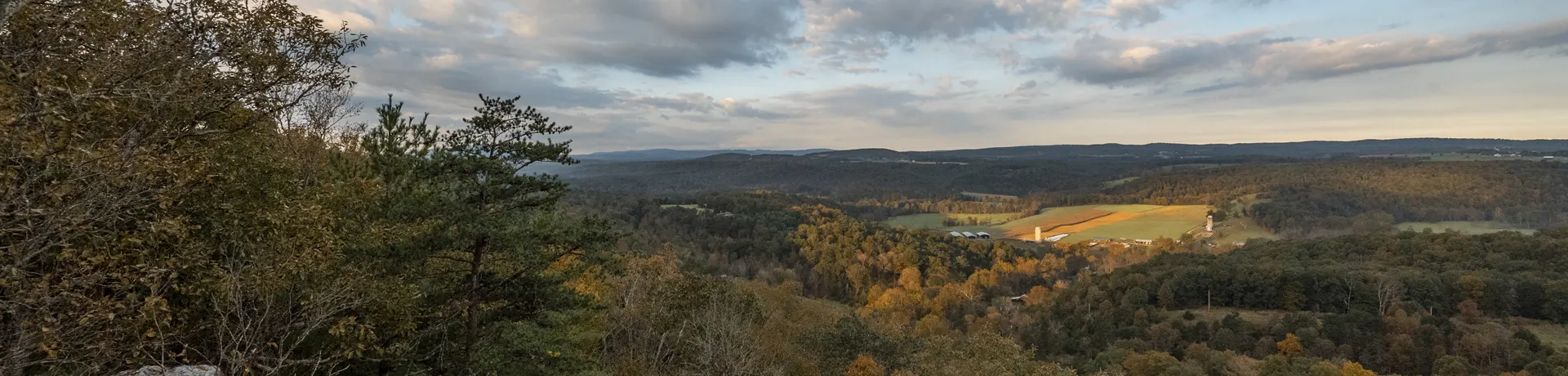

For Stephen Slonaker, protecting his land isn’t just about today’s crops or this year’s harvest. It’s about certainty — the kind that stretches far beyond one lifetime.
The Slonaker family has owned and farmed land along Dillons Run for more than two centuries. Stephen remembers a different time growing up on the farm.
“I remember when the only light you could see at night was the moon,” he says. “That’s when I started to fall in love with my land.”
But over the years, the landscape around him began to change. Neighboring farms were sold, subdivided, and developed. Land that had once been open fields slowly filled with houses.
Stephen had seen the pressures of development up close. In the 1960s, a Virginia power company used eminent domain to cut massive power lines through the family’s land. Later, as a Hampshire County commissioner, he worked to guide growth responsibly — advocating for what he called “quality growth” rather than “greedy growth.” Delivering new roads, utilities, and services required careful planning, and he believed communities should grow thoughtfully.
Still, the changes kept coming.
One night in 2012, after a long commission meeting, Stephen was driving home. As he crested the hill above his farm, he imagined what the view might look like if development continued.
In his mind, houses filled the fields below.
That moment stayed with him.
“As long as I’m here,” he vowed, “there aren’t going to be houses in my fields.”
That conviction led Stephen to protect his 420-acre farm with a conservation easement. The agreement ensures the land will remain intact forever — able to continue as a working farm or, if nature takes the lead, return to wildlife habitat.
For Stephen, the decision is also about honoring the generations who came before him. His parents and grandparents worked this land and carried it through difficult times, including the Great Depression when other family properties were lost.
Their sacrifices are the reason the farm still exists today.
The conservation easement also helped restore part of the farm’s history. The financial benefits made it possible for Stephen to purchase an adjoining parcel that had once been part of the original farmstead — land that was slated for development. Reuniting it with the farm helped make the landscape whole again.
Protecting the land is Stephen’s way of honoring the past — and safeguarding the future.
Because for him, the promise remains simple:
“As long as I’m here, there aren’t going to be houses in my fields.”
Today, thanks to his conservation easement, the fields along Dillons Run will remain open — a working farm, a refuge for wildlife, and a piece of Hampshire County’s landscape that will never be divided.
Stories like Stephen’s are why land protection matters.
If you care about keeping farms intact, protecting wildlife habitat, and ensuring the Cacapon watershed remains healthy for generations to come, learn more about how conservation easements work.
Contact the Cacapon & Lost Rivers Land Trust to start the conversation.