
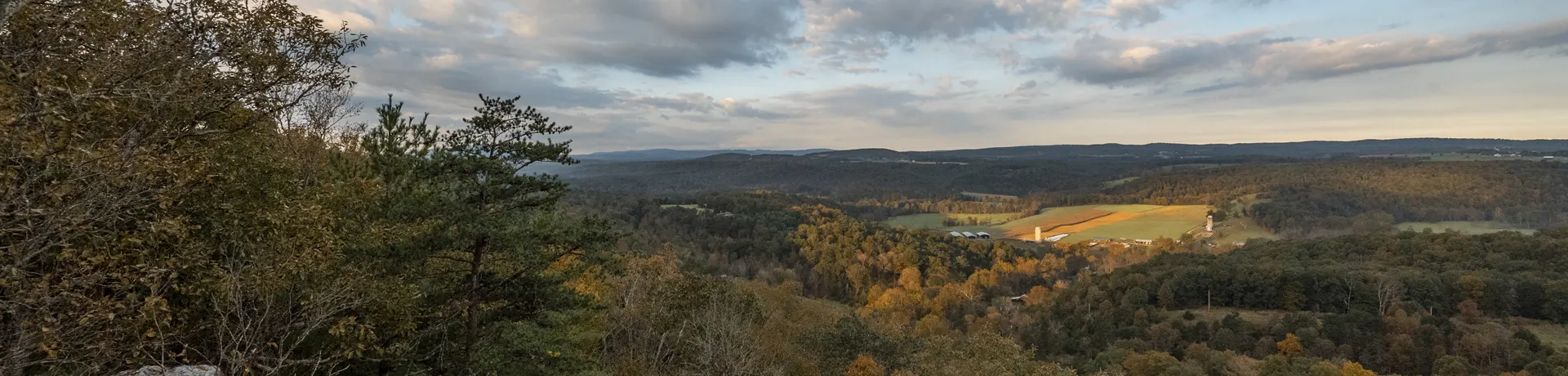

While the full Cacapon Watershed Collaborative (CWC) comes together quarterly to align priorities and adapt to changing conditions, much of the real progress happens in smaller, focused working groups. These groups bring together conservation practitioners, landowners, agency staff, and partner organizations to turn shared goals into coordinated action across the watershed.
Each group focuses on a critical part of the landscape. Together, they translate science, data, and local knowledge into on-the-ground conservation that reflects both ecological needs and community realities.
Forests Working Group
Protecting the backbone of the watershed
Co-Chair: Jarred Kinlein
Forests define the Cacapon Watershed, shaping water quality, wildlife habitat, and climate resilience. The Forests Working Group focuses on conserving forest cover while promoting responsible, long-term forest management.
The group works to:
- Prevent net loss of forest cover across the watershed
- Expand forest management plans that support long-term forest health
- Improve connectivity between intact forest patches to support wildlife corridors
Group members include:
Jarred Kinlein; Herb Peddicord (Forester); Charles Copeland (WV Division of Forestry); Jeremy McGill (WV Division of Forestry); Todd Miller (The Nature Conservancy)
By coordinating expertise across agencies and conservation organizations, the group helps ensure forests remain both ecologically resilient and economically viable.
Farms Working Group
Keeping working lands working
Co-Chair: Becky Royal
Agriculture is a defining feature of the Cacapon landscape and a cornerstone of the rural economy. The Farms Working Group focuses on supporting farmers and landowners who are balancing production, stewardship, and increasing development pressure.
The group’s priorities include:
- Keeping farmland in active agricultural production
- Expanding access to technical assistance and financial support programs
- Supporting voluntary land protection strategies that help families retain ownership of their land
Group members include:
Becky Royal (USDA-NRCS); Dottie Eddis (Landowner, CLRLT); Henry Ireys (Landowner, CLRLT); Dave Parker (Farmer); Candace DeLong (WVU Extension); Julee Halterman (Farm Service Agency); Leah Bittinger (WV Conservation Agency); Chloe Smith (Farmer); Kim Dollinger (Farmer)
This group ensures that conservation strategies align with real-world agricultural needs and the long-term viability of family farms.
Streams Working Group
Restoring water quality and aquatic habitat
Co-Chair: Ryan Cooper
Healthy streams connect forests, farms, and communities throughout the watershed. The Streams Working Group focuses on improving water quality, restoring stream function, and enhancing aquatic habitat.
Key areas of work include:
- Strengthening riparian buffers to reduce erosion and runoff
- Monitoring biological indicators of stream health
- Restoring and expanding native brook trout habitat
Group members include:
Ryan Cooper (Trout Unlimited); Joel Cockerham (Conservation Institute); Maria Russo (WV Rivers Coalition / CCWC); Karli Rogers (U.S. Geological Survey); Kate Pacelli (Friends of the Cacapon River); Glenn Archer (Friends of the Cacapon River); Sam Canfield (WV Department of Environmental Protection); Mary DeWees (WV Department of Environmental Protection)
Through shared monitoring and coordinated restoration, the group helps ensure that improvements are measurable, strategic, and lasting.
Easements Working Group
Securing long-term land protection
Co-Chair: Emily Merrill
Permanent land protection plays a critical role in maintaining ecological integrity across the watershed. The Easements Working Group focuses on voluntary conservation easements that allow landowners to protect conservation values while retaining ownership.
The group works to:
- Identify high-priority lands for permanent protection
- Coordinate easement strategies across partner organizations
- Support landowners exploring long-term conservation options
Group members include:
Emily Merrill; Alison Jewell (Hampshire County Farmland Protection Board)
By aligning land protection efforts across organizations, the group helps maximize conservation impact and maintain connected, resilient landscapes.
Working Together, Across Scales
Each working group has a distinct focus, but none operates in isolation. Information flows between groups, progress is tracked against shared goals, and strategies are adjusted as conditions change. This structure allows the Collaborative to respond to immediate challenges while remaining grounded in a long-term vision for the watershed.
Just as importantly, this work is rooted in relationships. With roughly 85% of land in the watershed privately owned, conservation here depends on trust, collaboration, and respect for landowners and local communities. The working groups provide a structure where those relationships can translate into meaningful, lasting stewardship.
Interested in learning more or exploring ways to get involved? Please contact us at (304) 856-1188 or email at info@cacapon.org