
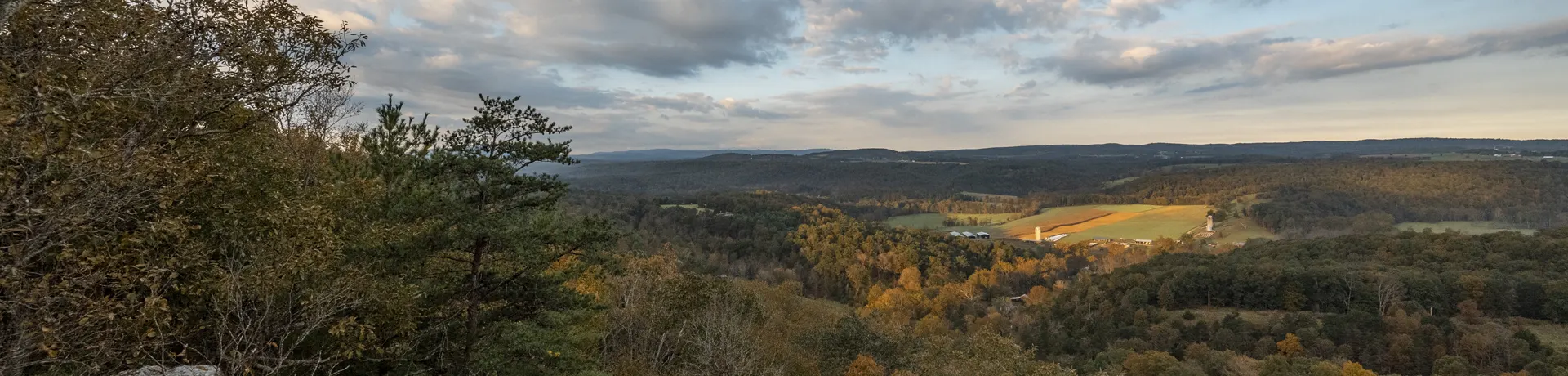
If you drive back the narrow lane at Dillon’s Run in Hampshire County, past the white clapboard farmhouse where Steve Slonaker’s parents lived and through a pasture kept tidy by grazing cattle, you end up at the edge of the woods. That’s where Steve and his wife Judy built their own house and where they like to sit on their porch watching birds and the deer wander along the treeline. Steve says the forest is where he goes to clear his head. The calm, as he puts it, just makes him “feel better.”
It’s a view his family has looked at for a long time. The Slonakers came over from Pennsylvania not long after the American Revolution, and they’ve been farming here ever since. Steve’s grandfather wouldn’t cut timber for sale. He hated to watch the trees come down, and some of the huge oaks he refused to cut still stand around Steve’s house today.
So it’s not hard to understand why Steve takes the idea of a second high-voltage transmission line across his farm so personally. He’s already lived with the first one for more than sixty years.
The first line
Steve still remembers the day two strangers pulled up in a black sedan. They were from Virginia Power and Light, and they had news the family hadn’t heard a whisper of: a transmission line was coming “right over the mountain and through the valley,” straight through the farm.
The offer was thirty dollars an acre for the right-of-way. Steve’s father and grandfather said no. It wasn’t about the money. They just didn’t want the line at any price. The offer went up to sixty dollars an acre, along with a warning that this was the final offer. Take it, or go to court.
That’s when the family learned a term they’d never heard before: eminent domain. “We had never heard tell of it,” Steve says, “but we soon found out.” Hiring a lawyer was a big step for a farm family. “Of course the power company has attorneys all the time,” he says. “It was just an everyday procedure for them, but for us it was a life-learning experience.”
While the case was pending, the crews went to work. Old oak trees were felled and cut into pieces too short to be good for anything but kindling. Then came the family orchard, which the Slonakers had tended for generations. Bulldozers pushed a forty-foot path right through it in the middle of summer, before the apples could be picked. “They could’ve avoided that patch of orchard and worked on either side,” Steve says, “but they didn’t. They just pushed the trees out.”
He remembers how hard it was on his father and grandfather, waking up morning after morning to the sound of machinery tearing into land they’d cared for so carefully. “It about broke my dad and my granddad’s hearts,” he says. “There’s a big gash through the center of it, up over the side of the mountain. It’s still there. It’ll always be there.”
When the family finally got their day in court, the judge upheld the power company’s right to take the land. Steve has never forgotten the reasoning: the rights of the few cannot deny the needs of the many. In the end, the family got one hundred and twenty dollars an acre “to put up with this for the rest of my life,” Steve says, “and whoever owns this farm in the future, for the rest of their lives.”
Now, another one
These days there’s a new transmission line proposed, and it could run right beside the old one.
“I’ve had to look at this thing since the ’60s,” Steve says, looking out across his
open fields. “And then to see another line being built across the middle of my farm, it’s just so disheartening.”
He doesn’t mince words about who he thinks benefits. “I feel like the people that are affected by this transmission line are being taken advantage of by big corporations, data centers and multimillionaires,” he says. “We’re giving up land we’ve lived on, in my case all my life, for peanuts while they make millions of dollars over the years. And this is here forever. It’ll be here after I’m gone.”
Steve is honest that he may not live to see a new line go up. But he knows it’s proposed, and he knows what it would mean for the place he’s worked to protect. He put his farm under a conservation easement for one reason: to make sure it would stay the way he remembers it. “This destroys all that,” he says, “if they build another line through here.”
“Upgrade the one that’s here”
Steve isn’t saying the power doesn’t need to get from one place to another. What he’s asking is simple: use what’s already there.
“Since we already have one existing line, my hope was that they could upgrade the line that’s here rather than build a new line beside of it,” he says. Refurbish it, rebuild it, whatever it needs. A brand-new line “takes another swath out of my farm. It just takes too much away from my place.”
No price that makes it right
You might wonder whether a bigger check would change his mind. It wouldn’t.
“Maybe it’s selfish, but at my age, there’s no compensation that would justify it for me,” Steve says. “It wouldn’t matter to me how much money they would offer. I still would not want it to be built.”
That’s the same answer his father and grandfather gave those strangers in the black sedan all those years ago. Back then, the family learned that saying no doesn’t always stop a project. But Steve’s grandfather taught him something that has stuck with him his whole life: not everything has a price. “Everything today seems to have a price,” Steve says. “If the price is right, it’s for sale. Not for my granddad. Money was just not a big issue for him.”
For Steve, the land is tied up in memory: the smell of freshly plowed sod every spring that brings back his granddad, the sound of rain coming through the leaves at night, the whippoorwills and owls he fell asleep to as a boy. “You grow up and your existence is tied to the land,” he says. “You can move away and do different things, but it never leaves you.”
One power line already cut through that. Steve is asking that it not happen twice.
Footnote:
The Slonaker Farm’s conservation easement protects it against many kinds of development, and it may be effective in persuading Valley Link to re-route its proposed transmission line. However, state and federal law give government the power of eminent domain, which is the power to take private property and convert it to a public use. That power supersedes conservation easements. If a government entity were to grant that power to Valley Link, then Valley Link would have the power to run a second transmission line through the Slonaker Farm. Conservation easements have deterred transmission lines in other areas of the county, and we are hopeful Valley Link will respect them, as well.