
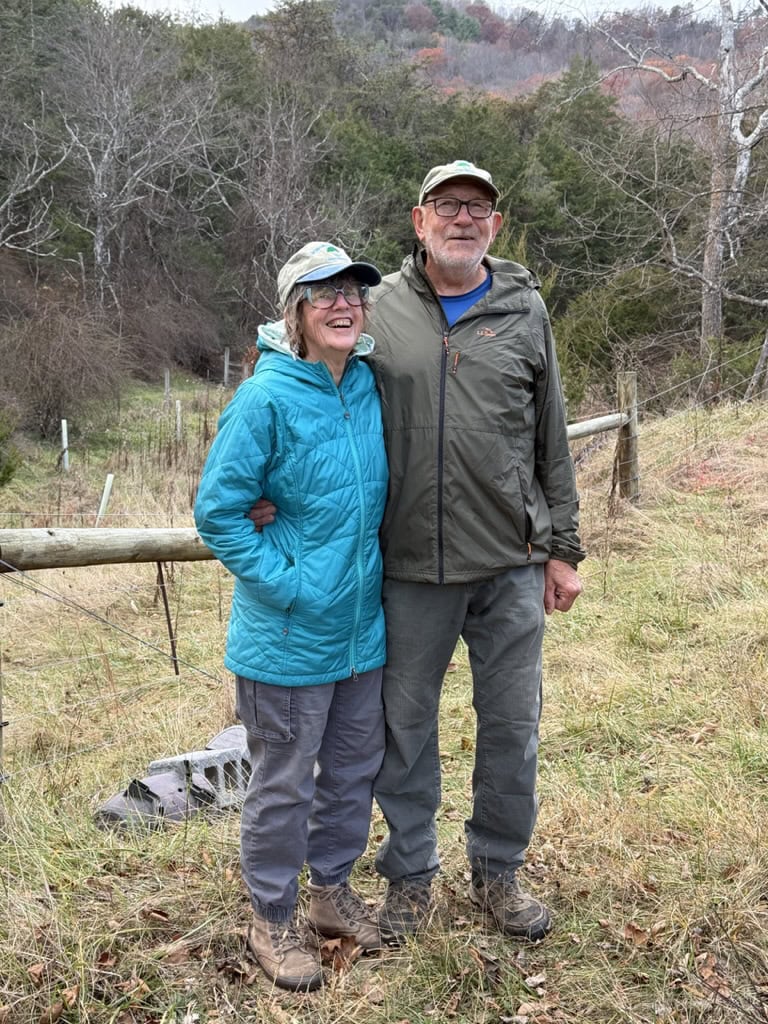
The Cacapon and Lost Rivers Land Trust is proud to announce Hope and Bev Yankey of Wilding Woolly Farm as the 2025 Cacapon Conservation Champions, honoring their 45-year commitment to exemplary land stewardship, watershed protection, and community leadership in the Cacapon and Lost Rivers region.
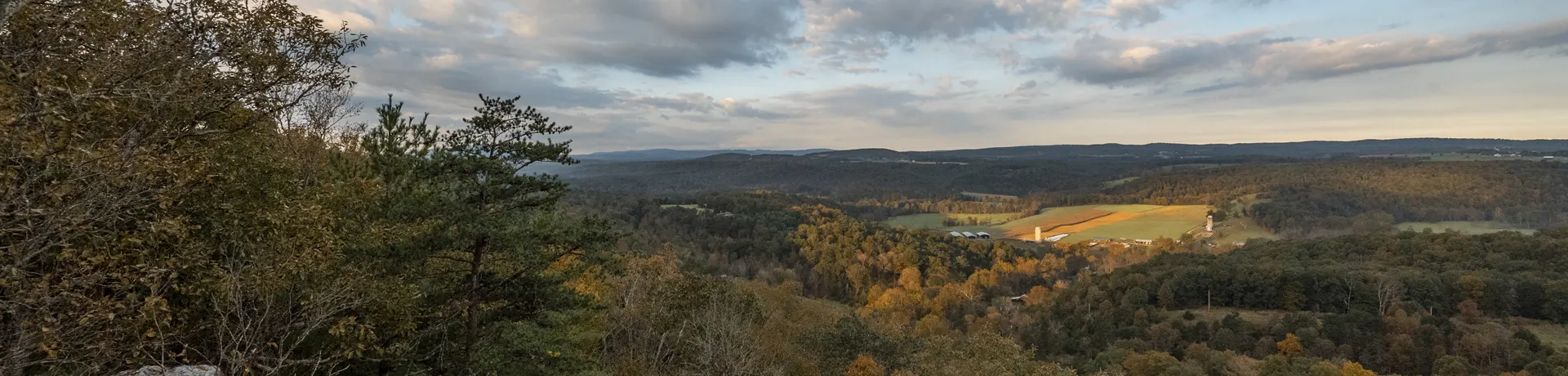
Nestled at the base of Bald Knob Mountain in Hardy County, the Yankeys’ 167-acre farm is a model for working lands that protect natural resources while sustaining a viable agricultural livelihood. Since the mid-1980s, Hope and Bev have implemented conservation practices that meet and exceed the award’s criteria, which recognize individuals and groups who:
- Demonstrate an unwavering commitment to protecting natural resources, farmland, forests, and the rural heritage of the watershed.
- Engage others to improve conservation outcomes across the region.
- Provide exceptional support and counsel to the Land Trust and its mission.
- Maintain strong standing within the community and their field.
A Legacy of Conservation Leadership
The Yankeys’ conservation journey began soon after Hope purchased the farm at the headwaters of the Lost River in 1981. By the mid-1980s, they were installing one of the region’s early sets of water-protection practices—spring-fed watering systems paired with livestock exclusion fencing to protect streams.
In the early 1990s, they launched a comprehensive effort to balance productive agriculture with ecological restoration. Their work has included:
- Regenerative soil and grazing management: Reducing herd size, limiting stocking density, and rotating sheep and cattle to promote pasture diversity, reduce parasites, and restore soil health.
- Waterway and habitat protection: Removing livestock from streams, ponds, and forested areas; leaving snag and mast trees; adding wildlife escape ramps to water facilities; and delaying mowing to protect nesting wildlife.
- Pollinator and wildlife habitat creation: Planting native grasses and wildflowers, erecting bird houses, practicing edge-feathering, and creating brush and wood piles for small animal cover.
Most recently, the Yankeys have undertaken large-scale restoration and reforestation projects. In 2022–2023, with support from the Natural Resources Conservation Service, Farm Service Agency, and Trout Unlimited, they planted 1,050 hardwood trees and 40 pines across 22 acres that were better suited to forest than agriculture. In 2024, Trout Unlimited constructed 10 in-stream log structures and helped plant additional trees and 55 native shrubs to restore stream function and riparian habitat.
Today, Hope and Bev are working with the Land Trust on a permanent land protection agreement to safeguard their farm and the Lost River headwaters for generations to come—a step that reflects both their long-term vision and the spirit of the Conservation Champion award.
Community Engagement and Regional Impact
The Yankeys are not only practitioners of conservation, they are teachers and advocates. Since 2018, they have mentored a young couple in sheep-rearing and gradually transitioned their farming operation to them. They regularly host farm tours and educational visits to demonstrate conservation practices firsthand and connect landowners with agencies who can help them adopt similar strategies.
In May 2025, Hope joined Land Trust staff in Washington, D.C., speaking during Land Trust Alliance Advocacy Days about the urgent need to protect West Virginia’s farmland, wildlife habitat, and rural communities. Her lifelong dedication to the land has made her a tireless voice for conservation statewide.
“We cherish this place and its way of life,” Hope says. “Protecting it is both our responsibility and our joy.”
About the Award
The Cacapon Conservation Champion Award recognizes individuals, groups, and nonprofits whose actions significantly advance conservation across the Cacapon and Lost Rivers watershed. Recipients embody the core values of stewardship, community engagement, and partnership with the Land Trust. Hope and Bev Yankey exemplify these values in every facet of their work.